Motor Ignitors
The Ignitor
The Purpose
The ignitor is a component that is used to ignite the rocket motor from a safe distance. For something (rocket motor in our case) to ignite, it must fulfil the fire triangle, notably:
- Oxygen: An oxidizing agent that supplies oxygen for the combustion process (air or Potassium Nitrate, explored further under Propellants
- Fuel: Something that can continuously supply combustible material to sustain the fire,explored further under Propellants
- Ignition Source / Heat: Anything that can start the fire in the first place, such as intense heat or a spark, that shall be explored in this article
Since our oxidizer and fuel are already part of the propellant mixture, all that's left is an ignition source to complete the fire triangle.
Hypergolic fuels, can instantly ignite when the oxidizing agent and the fuel are brought contact with each other, hence eliminating the need for an ignition source. Until the point of ignition, the oxidizer and fuel are isolated from each other.
Method of Ignition
This component of the fire triangle is the most easiest to control and is vital for initiating the fire and although there exists multiple methods of ignition, such as a manual wick. or a safety fuse (the long gunpowder coated cord that burns at a steady rate). However the most popular method and the one that we'll be using is the electrical ignition.
It basically works by passing high amount of current through a very thin section of a wire or one with a high resistance or both as resistance is directly proportional to heat and high heat can complete the fire triangle.
Insight on v1 ignitors
The v1 ignitors consisted of nothing more than a single strand of copper wire (2cm to 5cm) from an old speaker wire (these were much thicker). After being inserted into the engine, the ends were either clipped to alligator clips or were just twisted with the ignitor cable. Most of the time, ignition would not occur; either the ignitor would have come loose or it would slip from the engine or would not get enough current for it to melt. Even if ignition had occurred, it would be away from the target, near the twisted part of the ignitor cable hence melting and breaking the circuit.
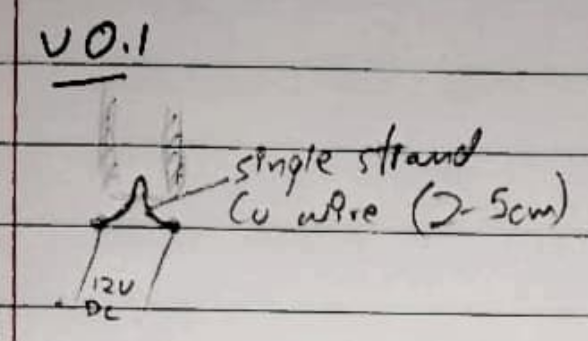 |
| sketch of v1 ignitor |
Next Iteration: v2 ignitors
The new launch igniters are based on a design by Grant Thompson. Although these ignitors consume much resources and higher build time, these are much efficient and reliable than the previous version.
Construction of v2 ignitors
- An old mobile charger wire is obtained, and cut into two inch individual pieces.
- Using pliers, the whole bunch of inner copper strands along with their nylon counterparts is removed.
- The speaker wire is snapped into two inch pairs. The outer jacket is snapped at both ends.
- Grooves are made between the pair at both ends with one end being significantly deeper than the other.
- A matchstick (the wax version) with a groove on its head is placed in the deeper groove just that its head ends in the same axis of the ends of the exposed copper strands.
- An individual copper strand (obtained in step II) is separated from the bunch. Its midpoint is placed on groove of the matchstick with its both ends twisted firmly to the exposed strands of the speaker wire.
- These twisted strands of the upper end are bent downwards.
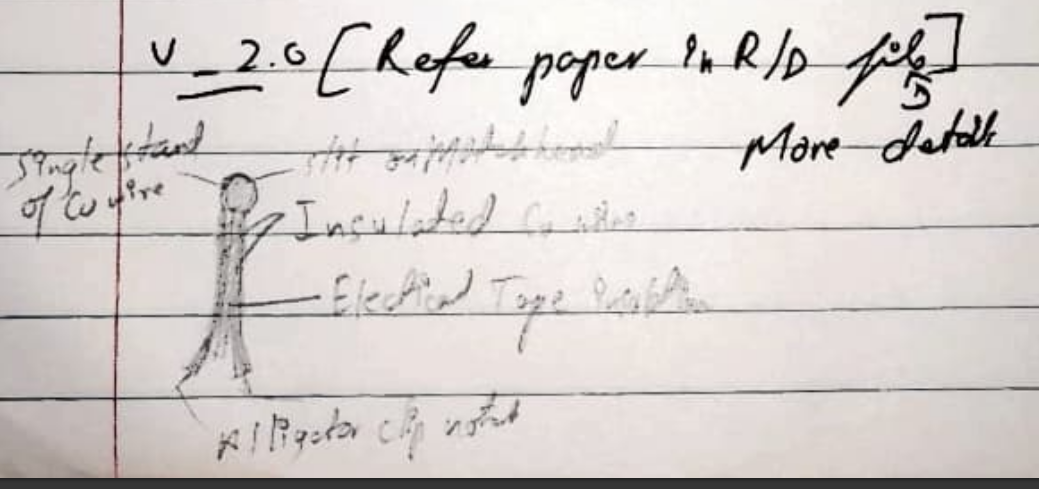 |
| sketch of v2 ignitor |
Pros of v2 ignitors
- Very much reliable
- Although not reusable, but refurbhisable. After the first burnout, the burnt match could be easily pulled out using the pliers, a new match is inserted and a new copper strand (from the charger wire) is twisted on both sides of the speaker wire and is ready for its next ignition. This could be repeated for over five to six cycles until the speaker wire and the tape burns irrecoverably.
Cons of v2 ignitors
- Increased manufacturing time.
- Increased amount of resources (although it could be reused for a few cycles).
The Final Iteration: Glow Plug Ignitor
The traditional ignition methods discussed used a fuse wire that melts a huge amount of current passes through it or this fuse wire is plugged with a black powder. In both cases, the fuse wire is expended. But if higher ignition temperatures are needed, as highlighted the [fuels](fuels) section, when we moved on to KNO3/sugar based propellants with 3D Printed nozzles. A simple but reliable solution was to use a diesel glow plug as the launch ignitor, as it can produce greater ignition temperature in a matter of seconds and it is also reusable and can be permanently mounted to the launch pad structure.
 |
| fig of a diesel glow plug |
As tested on field, this proved to extremely reliable and easily compatible with the high power requirements we were moving towards.